Movement Dice: 0
Swimmer Bonus: 0
Movement Dice: 0
Swimmer Bonus: 0
Congratulations!
Top scores from recent games
| Rank | Winner | Opponent | Score | Date |
|---|---|---|---|---|
| No games played yet. Start playing to see your scores! | ||||
Score = Winner's Pieces Home - Opponent's Pieces Home
The score represents how decisively you won. A higher score means you got more of your pieces home compared to your opponent. Maximum score is 24 (if playing with 24 pieces and opponent has 0 home).
2025, Version 1
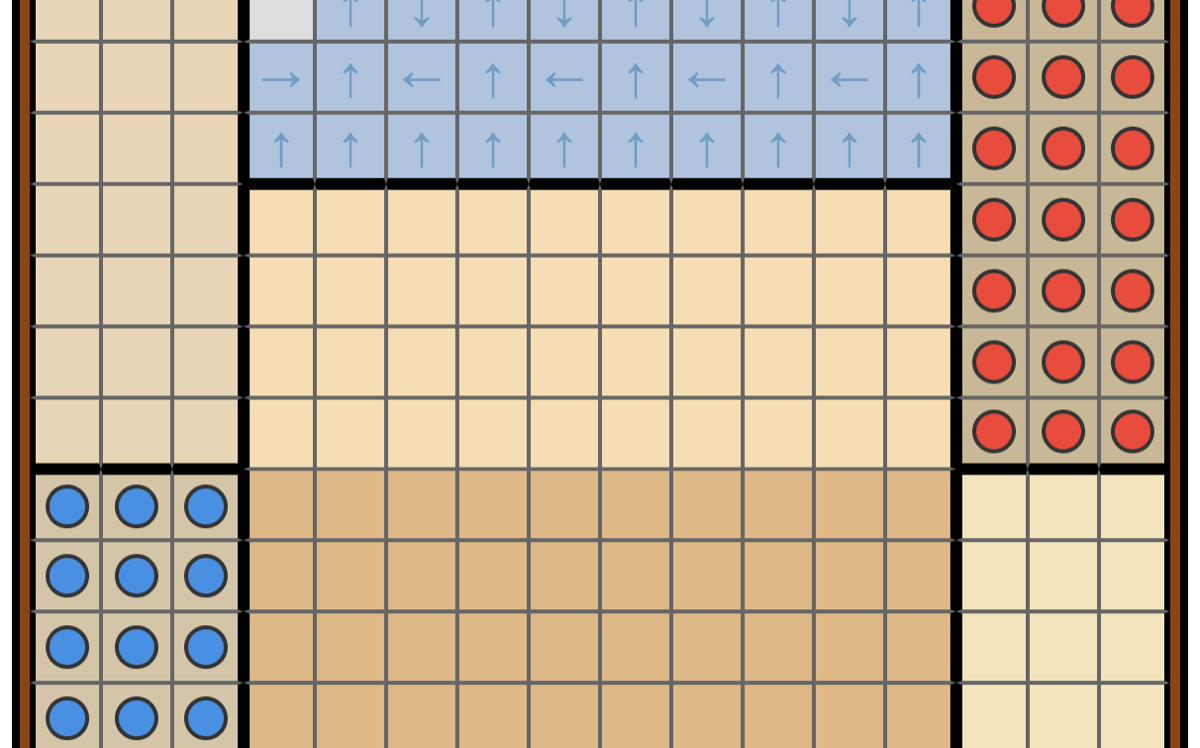
There are two islands joined by a causeway that passes over a shallow narrow channel of water. Some workers (playing pieces) live on one island and work on the other. At the end of the working day they all return home via the causeway. They are all tired and in a bad mood, so fights break out as they pass each other. Some are pushed into the water, some are injured and have to return to their place of work to receive first aid. This game simulates that action.
Players sit on opposite sides of the board facing each other. At their left-hand end of the board is a promenade area where their 24 pieces start their journeys home. The area at the right-hand end is their destination. The central section is the causeway, divided into ten equal strips with a dividing line halfway across the causeway. On either side of the causeway is the waterway, divided into squares. Swimmers move one space at a time at the start of their move, over the dotted lines and between the wavy lines.
Now throw that number of dice determined from the four dice at the beginning of your turn.
When all of the moves have been made, resolve the conflicts. These will be in accordance with the table below.
A player must have more pieces on a strip to win a conflict. An equal or lesser number than the opponent has, cannot start a conflict.
| ODDS | RESULTS | ||
|---|---|---|---|
| Player | Opponent | PLAYER | OPPONENT |
| 2 | 1 | One back | One swims |
| 3 | 1 | One back | One swims |
| 3 | 2 | One back | Two back |
| 4 | 1 | No loss | One swims |
| 4 | 2 | Two back | Two swim |
| 4 | 3 | One back | Two back |
If two opponents are forced to swim, one lands in the water beyond the other.
The second player makes the same sequence of actions after the first player to complete a turn. Players must have an equal number of turns in a game, so the first player cannot claim victory until the second player has had his turn of play.
The aim of the game is to get all of your pieces remaining in play to your home area and for this number to be greater than the opponent has already moved to his home area. If that number is equal, count who has the nearer swimmer. If the first swimmers are equally far away from the step, continue until one of a subsequent pair of swimmers is counted as being nearer the step. If the matter is still not resolved, you have a drawn game.
If your opponent has already moved more pieces home than you have still in play, then you must concede defeat.
Strategy: Makes random legal moves with no strategic planning
Behavior: Unpredictable and chaotic play style
Best for: Learning the game or casual play
Philosophy: Seek conflict - attack and capture enemies
Tactics:
Best for: Players who want to dominate the board and force conflicts
Philosophy: Avoid conflict - prioritize safety and groups
Tactics:
Best for: Careful, strategic play focused on piece preservation
Philosophy: Tactical flexibility - strike when safe, defend when vulnerable
Tactics:
Best for: Well-rounded competitive play that adapts to situations
| Behavior | Aggressive | Balanced | Defensive |
|---|---|---|---|
| Enemy on strip (safe) | +800 (attack!) | +500 (capture!) | -1000 (avoid!) |
| Enemy on strip (risky) | +800 (attack!) | -400 (avoid) | -1000 (avoid!) |
| Being alone | +100 | +50 | -200 |
| Near enemies (backed up) | +50 (threaten) | +30 (pressure) | -30 (caution) |
| Near enemies (alone) | +50 (threaten) | -80 (risky) | -200 (danger!) |
| Forming groups | +500 (barrier) | +500 (barrier) | +600 (barrier) |
| Philosophy | Seek conflict | Adapt tactically | Avoid conflict |
Tip: Try different AI matchups to see how strategies compete - Aggressive vs Defensive creates dynamic conflicts, while Balanced provides adaptable competition!
Game Design:
John Watling & Ollie Breen
Digital Implementation:
Lawrence Watling, Alannah Watling & Shelley Watling
Built with:
Claude Code by Anthropic
December 2025